
Alphonse Dumais was born on the Fourth of July, 1898, in Kamouraska, Quebec, which is a detail that seems almost too obvious, the kind of biographical fact a fiction writer would cut for being too on the nose. He emigrated to the United States in 1914, and he became a naturalized citizen while in California in 1935, a French-Canadian man who crossed a border and disappeared into the working fabric of a country that was, eight years later, going to send him to the Gilbert Islands to die.
He was killed on November 20, 1943, at Betio, in the first hours of the Battle of Tarawa. He is commemorated at the Honolulu Memorial in Oahu. He was my grandfather Valmore’s uncle, which makes him a great-great-uncle of mine, and he is the closest thing I’ve found, in two hundred and fifty years of family history, to an ancestor who was killed by another soldier.
I’m spending a lot of my time this year with dead people. The project I’ve been working on has required me to sit with military records and hospital registers and census data and pension files, to follow four family lines from the founding of the country to the present, and on this Memorial Day morning I’ve been going through every military event in my family tree, asking who served and who didn’t come home.
I found four of them.
Edmund Jackson III served in the Massachusetts militia in November of 1776 and died that same year, his wages accepted by his captain with no record showing that Edmund ever collected them. The wages going uncollected is the tell: that’s what it looks like in the archives when a man dies before he can receive his pay. He was at Mount Independence, the Revolutionary War garrison on the Vermont shore of Lake Champlain, a place where more men died that winter from dysentery and smallpox and exposure than the British ever managed with muskets.
Jedidiah Blaney, Jr. was counted present in Capt. Thomas Fish’s company of Col. Shepard’s Massachusetts regiment on April 15, 1777. Three days later, he was dead. Three days. Shepard’s regiment was in the Morristown winter encampment in the spring of ’77, Washington’s army rebuilding itself after Trenton and Princeton, and what moved through those camps that season was typhus and smallpox and the dysentery that ran through every winter camp the Continental Army ever made, moving from tent to tent faster than any order of battle.
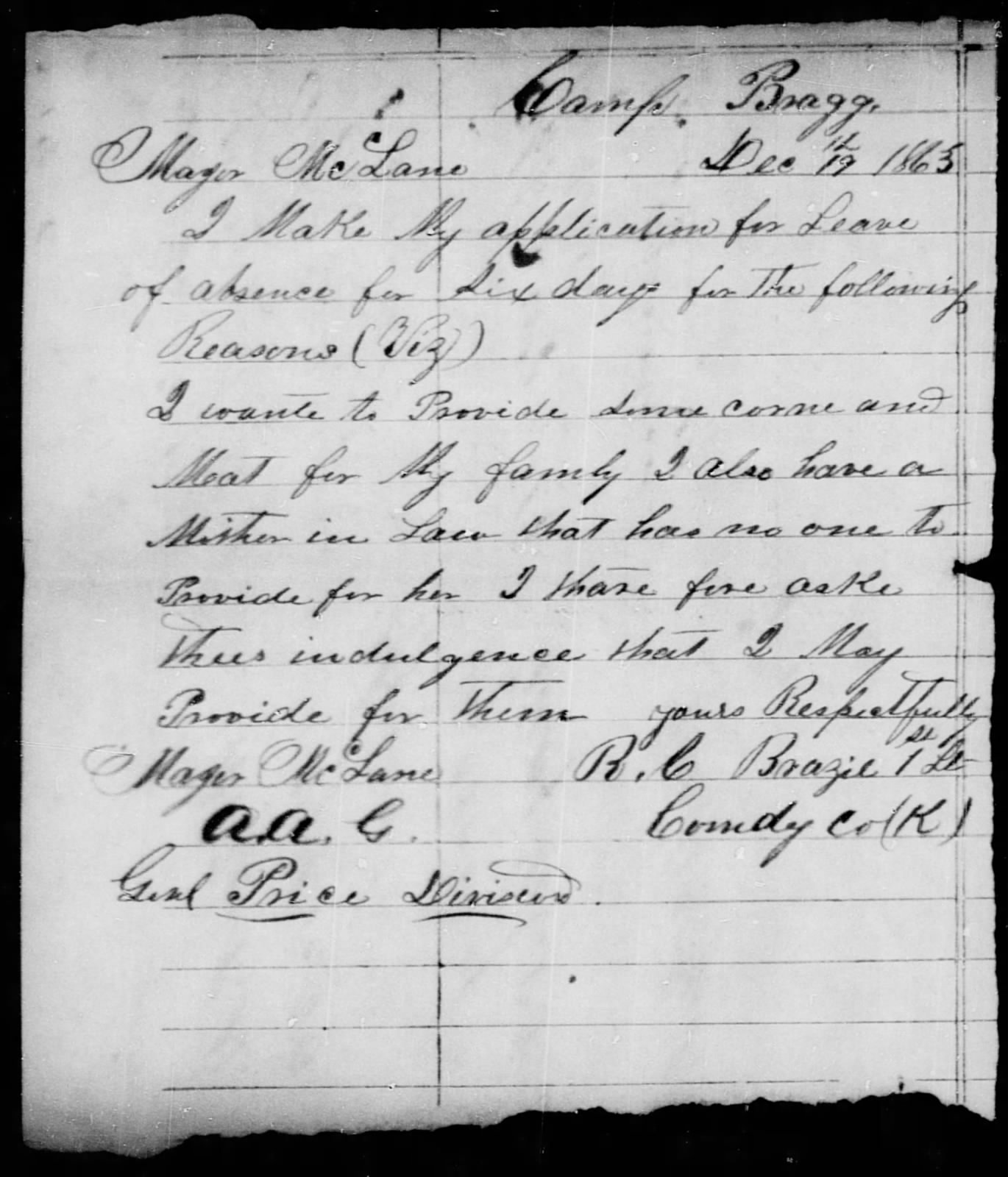
Robert C. Brazil was a First Lieutenant in Company K of the 33rd Arkansas Infantry, Confederate States of America, under General Sterling Price. He survived Iuka. He survived Corinth. He survived the failed assault on Helena in the summer of 1863. In December of that year, from a winter camp in Arkansas, he wrote to his commanding officer requesting a six-day furlough so that he could provide corn and meat for his family and his mother-in-law, who had no one else to provide for her. He was twenty-six years old, and he was using his one furlough request to keep his people from starving. He was admitted to the C.S.A. General Hospital in Shreveport on April 1, 1864, diagnosed with gastritis. He was dead forty-eight hours later.
And then there is Alphonse Dumais, born on the Fourth of July, killed on a Pacific island, his name on a wall in Honolulu.
When you sit with the records long enough, you learn the bullets got almost nobody.
Disease killed roughly twice as many soldiers as combat did in the Civil War. The winter camps of the Revolution were slaughterhouses; the monuments remember them as something else. Robert Brazil survived three years of Confederate military service only to be killed in two days by what was in the hospital’s water or food or air. Edmund Jackson and Jedidiah Blaney died sick in garrison before the war had really started for them.
We have a story we tell about how men die in war, and it involves strategic positions and enemy fire and decisions made on fields of honor, the kind of story that resulted in the death of Master Gunnery Sergeant Dumais. The practical reality, across most of American military history, is that what kills you is what’s in your water.
The more astonishing thing, though, is how many of them survived.
Going through two hundred and fifty years of military service records in my family tree, I found dozens of ancestors who served in every American war from the Revolution through Vietnam: mariners and farmers and shoemakers and clerks, men drafted and men who volunteered and men who answered a call they had not issued, and each of them made it home: every single ancestor whose survival was necessary for me to exist, for my wife to exist, for my daughter to exist. The chain of survival from 1776 to the present is long and improbable, held together by luck more than valor, and I carry that luck without having asked for it, without deserving it, knowing I would not be here without it.
Four didn’t make it. The rest came home and had children who had children, and here we are.
Not one of these men made the decision to go to war.
Edmund Jackson was a Massachusetts colonist sent to a Vermont garrison by forces fighting a revolution he probably supported but certainly did not design. Jedidiah Blaney was a Marblehead man, from a fishing town, who answered a call from richer men fighting for their independence from a crown’s taxes. Robert Brazil was an Arkansas man, the son of a family that had moved west from South Carolina, a man fighting for a Confederacy whose leaders were wealthy planters protecting an economic system that left Robert Brazil using his furlough to find corn and meat for the people he loved. Joseph Dumais was a French-Canadian immigrant, a man so far from the geopolitical calculations that sent him to the Gilbert Islands that no version of his life from Canada to California connects to them.
None of them sat in a room and decided that America should go to war. None of them drew the maps or made the alliances or declared the interests that required young men to be present on those particular fields and beaches and in those particular tents. We are a family of mariners, farmers, shoemakers, clerks, laborers, wage-earners, homemakers, civil servants. We have also been, across two and a half centuries, the expendable material, drafted and sent and, for four of us, buried by rich men who faced none of those outcomes themselves.
I am grateful for their service. I am furious about the terms of it. I can and will hold both at the same time because the people who benefit from us not holding both are the same people who have always made the decision to go to war.
Alphonse Dumais was born on the Fourth of July. He is commemorated in Honolulu. He never knew the great-nephew his death left behind, or the great-great-niece his great-nephew would have, a teenager who is growing up in a world held together, in part, by enough of the others making it home.